For nearly three decades, Wantagh Middle School students have shown their commitment to heart health by raising money for the American Heart Association. This year, their donations exceeded $6,000, and the fundraising effort culminated with a basketball competition.
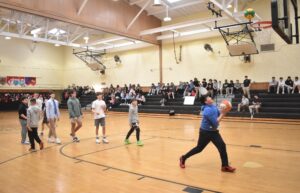
Hoops for Hearts began with preliminary rounds in physical education classes throughout February. Students who raised money for the American Heart Association were eligible to compete for a spot in the finals. On March 1, nearly 30 class winners competed in a basketball game of knockout. Eighth graders filled out the bleachers to cheer on the finalists. The walls were also covered in red and pink paper hearts on which students wrote messages or encouragement or tributes to family members who had heart disease.
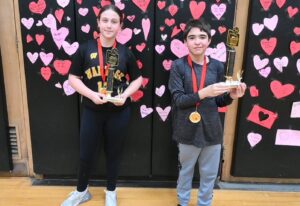
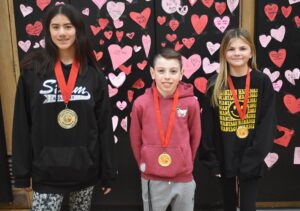
Seventh graders Ava DeVita and Lucas Tartakoff emerged as the schoolwide champions. The three top individual fundraisers were also recognized – Victoria Guber, $795; Landon Fusco, $750; and Maisie Stachlik, $368.
The 28th annual Hoops for Heart was organized by physical education teachers Deb DiBiase, Thomas Liguori, Eileen Keener and Gary Reh. During their classes, they educated students about the American Heart Association and how the money is used to help people with heart disease, in addition to giving students tips to maintain their own health.
“We want to convey to them how to live a healthy lifestyle and have a healthy heart,” Ms. Keener said.
Photo captions:
1: Wantagh Middle School students competed in a knockout game of basketball in the Hoops for Heart finals on March 1.
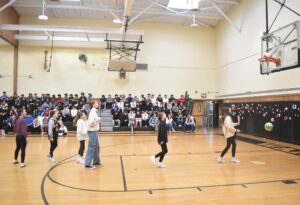
2: Participants, who won class competitions, warmed up for the final round.
3: This year’s top fundraisers for the American Heart Association were, from left, Victoria Guber, Landon Fusco and Maisie Stachlik.
4: Ava DeVita and Lucas Tartakoff were the top finishers in the Hoops for Heart finals.
Photos courtesy of the Wantagh School District


Last year, my 68-year-old partner was diagnosed with Lou Gehrig’s disease also known as ALS. Speaking and swallowing were two of his challenges. His collapse was swift and catastrophic, and neither the riluzole nor the medical staff did much to aid him. He would not have survived if our primary care physician hadn’t given him attentive care and attention, as the hospital center didn’t provide any psychological support. His fall was abrupt and catastrophic. His hands and legs gave way to weakness in his arms. This year our family physician suggested using vine health centre ALS/MND treatment, which my husband has been receiving for a few months now. I’m delighted to say that the treatment greatly reduced and reversed his symptoms of ALS, he no longer requires a feeding tube, sleeps soundly, works out frequently, and is now very active. In the hopes that it could be useful, I thought I would relate my husband’s tale; in the end, you have to do what suits you the best.